
Help Protect Private Trees and Trees Impacted by Development in Hamilton!
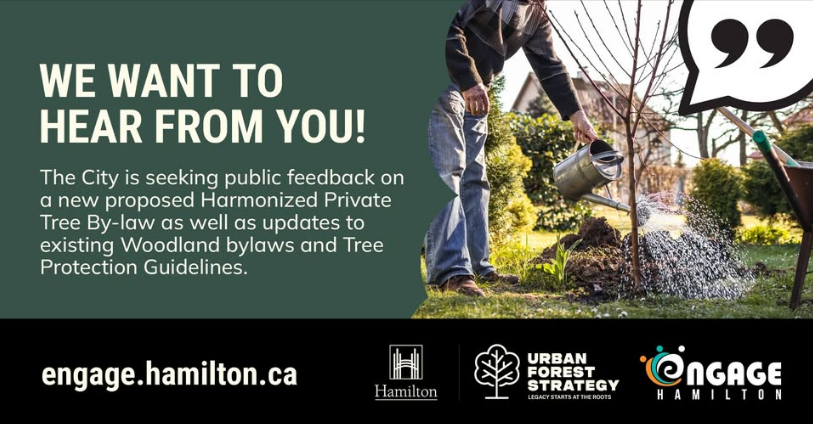
Comments needed for Hamilton's first city-wide Private Tree Protection Bylaw and Protection Guidelines Updates for trees threatened by development!
Deadline April 23, 2026 for:
-The proposed new Private Tree Bylaw
-Tree Protection Guidelines (development risk)
-Updates to existing Woodland Bylaws
Attend one of several public meetings or fill out the online survey. More info by clicking the image ——>
The Hamilton Naturalists’ Club has compiled some points for you to consider in your Private Tree Bylaw comments:
Enforcement - A truly robust Tree Bylaw would provide protection for more trees than currently proposed. This may require increased staffing levels for administration and enforcement. Hiring additional Staff to administer and enforce the protection of more trees than what this draft proposes, is appropriate.
Size of trees exempt from protection - 45cm diameter at breast height (DBH) is far too big and would exclude a significant number of mature trees from protection. Threshold should be 20cm DBH which is consistent with woodland protection bylaw. Several municipalities have lower protection thresholds including Toronto (30cm DBH and currently consulting on lowering further), Burlington(20cm DBH), Mississauga(15cm DBH).
Removal of dead or hazardous trees -While a no-cost permit is reasonable, the draft does not appear to require any form of post-removal documentation that would prove a tree was in fact dead or hazardous prior to removal. Toronto and Burlington do require this proof.
Strengthen requirements for permit applications to include arborist reports, detailed site plans, and defined tree protection measures during construction.
Replacement - Require adequate compensation planting or payment in lieu when tree removals occur to ensure the canopy is maintained. Replacing a mature tree with a sapling is not acceptable. Replacement trees should be native species only. Use Burlington’s replacement ratio:
▪ 2:1 for 20 to 30cm DBH
▪ 3:1 for greater than 30cm DBH
▪ 4:1 for greater than 75cm DBH
Cost of Permit - price the fee for the permit to ensure it is fully cost-recovery and acts as a barrier for tree removal.
Burlington: 1-3 Tree Removals Fee: $351.50 + HST
Mississauga: $399.77 + HST
Permit display - Removal Permits should be displayed in a visible location on site before work commences
Retroactive Fines - Residents should have up to 1 year to report a past illegal tree felling, not just six months. A tree’s absence might not be noticed until full leaf-out in the summer.
Add a mature tree subsidy - Homeowners need support to care for mature trees, should not have to bear full responsibility and liability for stewarding this resource that benefits entire community. City of London has subsidy program to help.
Protection of birds and nests - Many municipalities provide clear guidance within their bylaws around the requirement to perform nest sweeps prior to tree removal. This appears to be missing from the draft.
-Residents should have up to 1 year to report an illegal tree felling as a missing tree might not be noticed until the leaves are out.
Add a category for larger trees - Toronto is currently considering a Distinctive Tree category for large, healthy trees larger than 61 DBH that provide significant environmental and community benefits. Permits to remove these trees would require Community Council approval, while injury permits could continue to be approved by staff.
Invasive species - use Ontario Invasive Plant Council list for invasives as the regulated list does not capture full extent of invasives that need to be managed.
Help strengthen Tree Protection and Landscape Plan Guidelines for trees impacted by construction and development.
The goal of the Tree Protection Guidelines is the protection of private trees inside the Urban Boundary and rural areas, including Woodlands (public Trees are protected under a different bylaw: the Public Tree by-law) on lands subject to the following Planning Act applications:
• Draft plans of subdivision or condominium
• Official Plan and Zoning By-law Amendments
• Site Alteration permit applications
• Site Plan Control
• Consent applications (severances)
Some points to consider in your Tree Protection Guidelines comments:
Increase the compensation to 7:1 (for each mature tree removed, seven saplings must be planted) for large scale developments - the draft bylaw proposes to increase compensation ratios from 1:1 to 3:1. A replacement ratio of 3:1 is still not adequate. Developers who choose to build on treed properties must replace at a much higher level than only three sapling replacements for one mature tree.
Reduce the diameter at breast height (DBH) protection threshold from 10cm to 5cm - it can take several years for a tree to reach 9cm DBH and those trees should also be compensated for by developers.
Landscape Plan Guidelines - The draft proposes that only 50% of replacement trees outside natural areas are to be native. This should be far higher.
The easier it is for residents to navigate the by-law the better. That is why having a document like Burlington's "A Guide To Tree Protection" is so valuable with all of the necessary and relevant information included.